The Right-Wing Wave Just Hit Germany: Populists May Govern a State for the First Time

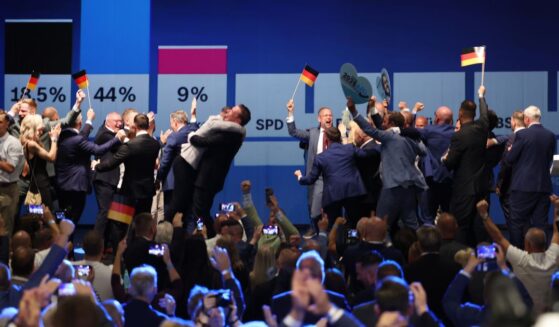
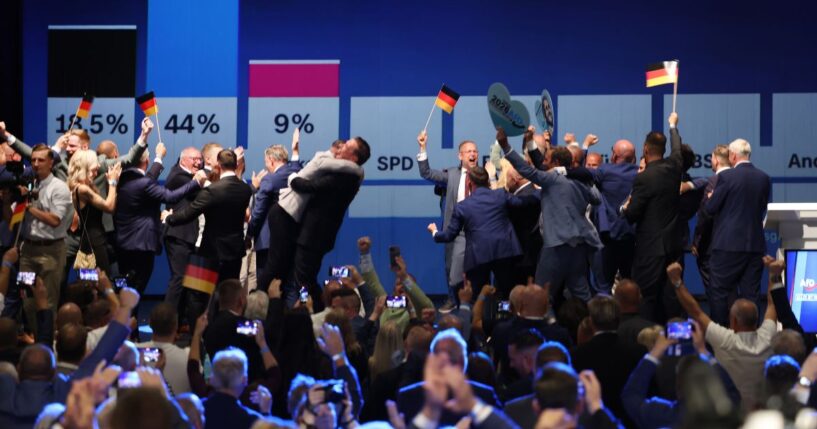
In the first major electoral victory for a populist party derided as “far-right” and shunned by most of Europe’s establishment, the anti-immigration Alternative for Germany is expected to finish first by a wide margin in state elections in Saxony-Anhalt held on Sunday.
While the party will still lack an absolute majority, according to The New York Times, the win marks the first time that the party — generally referred to by AfD, its German initials — has come out on top in a state election.
“Saxony-Anhalt is a relatively small state, and the heart of the AfD’s power base in eastern Germany,” the Times reported. “But the result has sent shock waves through the country’s political system, which was designed after World War II to prevent extremist parties from ever returning to power.”
“The political establishment has treated the AfD as a pariah, but the party tapped into voter frustration on a wide range of economic and social issues to win about 44 percent of the vote in the state, and was set to claim 39 of the 83 seats in the Parliament.”
Much of the vote came at the expense of the center-right party of the country’s current chancellor, Friedrich Merz.
As the BBC noted, Merz had come to power hoping to curb the AfD’s popularity, which had risen significantly after both mass migration from Eastern Europe, the Middle East, and North Africa — along with the center-left government of former Chancellor Angela Merkel refusing to implement strong border measures or send the migrants.
Merkel’s 2015 proclamation “Wir schaffen das” — “We can do it” in German, her response to criticism that the government could not safely assimilate new arrivals without cultural and economic upheaval — became her political epitaph.
It also led to the first surge in popularity for the AfD, which became the first party not in the centrist establishment or on the progressive left to attain any prominence in Germany since the end of Nazi rule in 1945.
While AfD will likely have to find partners to govern with, the overwhelming nature of their first-place finish Saxony-Anhalt showed Merz’s more conservative tack had not worked, either — and sends shockwaves through the country’s political establishment as it looks toward the country’s next federal election, which must happen before March of 2029.
“Germans simply are fed up with policy being made against Germany’s interests. We stood for election very clearly to represent the interests of our country – not Ukraine’s, not any other country’s,” said Alice Weidel, national co-leader of the party, after the polls closed, according to CNN.
“We’ve made history, and we’re taking our country back,” said Ulrich Siegmund, AfD’s state party leader. “It all starts here in Saxony-Anhalt.”
German leaders have long sought to have the AfD banned outright, with lawyers for the far-left German Society for Civil Rights declaring as late as this June that the party was “demonstrably unconstitutional” and a legal attempt to ban it would be “likely successful,” according to Deutsche Welle.
However, the Trump administration has been clear with European officialdom that the state of transatlantic alliances, particularly NATO, could be jeopardized if European countries meddle with elections by interfering with anti-establishment parties.
Notably, Vice President J.D. Vance’s speech to the Munich Security Conference in 2025, where he chastised the German defense minister and others for “hiding behind ugly, Soviet-era words like misinformation and disinformation” to quash parties like AfD, Reform in the United Kingdom, and the National Rally in France.
With Sunday’s results, however, questions about the future of populism in Europe — both practical and hypothetical — will be asked louder than ever.
Practically, the AfD will have to figure out whether it wants to go it alone as a minority party or try to find a partner to work with. CNN noted that while most of Germany’s establishment parties had pledged to work together to form a “firewall” against entering a coalition against AfD, the extent to which AfD dominated the polls made it clear that even by banding together, their coalition would still also represent a minority under Germany’s electoral process.
AfD co-chair Tina Chrupalla said the party was still willing to “extend a hand” to any party that wants to work with it as a majority government.
As the BBC noted, it’s likely that the erosion of support for Merz’s party, which lost half of its vote in the state election, likely reverberated across the continent.
“The next 12 months is bumper election season across the EU. Ballots are expected in key nations France, Italy, Spain and Poland. Brussels fears more ‘extreme’ parties, left but particularly right of the political spectrum, may benefit across the board,” the BBC’s report read.
In particular, National Rally in France and Vox in Spain have a significant chance of notching national electoral victories like AfD saw in Saxony-Anhalt.
In addition, while the United Kingdom doesn’t have elections any time in the near future, most likely, Nigel Farage’s Reform UK has been consistently ahead or near the lead in most national polls — and given the United Kingdom’s first-past-the-post parliamentary system, combined with the collapse of the traditional Labour-Conservative duopoly, that could mean the man who is widely seen as the motive force behind Brexit is the country’s next prime minister.
Advertise with The Western Journal and reach millions of highly engaged readers, while supporting our work. Advertise Today.
Truth and Accuracy
We are committed to truth and accuracy in all of our journalism. Read our editorial standards.