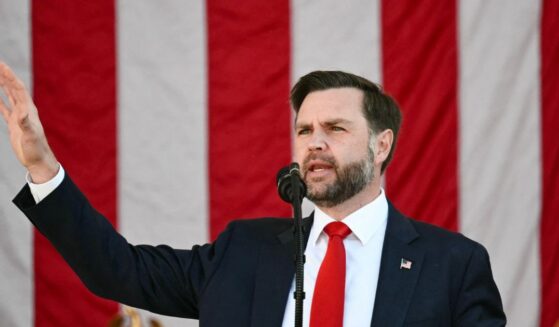
Vice President J.D. Vance will face important questions if he hopes to lead the Republican Party in 2028 and beyond. Here are three of them:
Mr. Vice President, when you went to sleep on election night in 2024, did you imagine that two years later, in November 2026, you would have to make a case against amnesty to members of your own party?
If not — and we suspect you didn’t — what happened?
Finally, and most important of all, can the party move forward as presently constituted?
Thursday on the social media platform X, Vance shared a clip of an interview featuring Republican Gov. Kevin Stitt of Oklahoma, who appeared to suggest that federal legislators could easily achieve a bipartisan deal on immigration reform that presumably would involve some degree of amnesty for illegal aliens, which the vice president denounced as “morally and electorally disastrous.”
“I just think other countries have figured this out. It’s not that complicated,” Stitt said in a Wednesday interview with Politico. “But the problem is Washington, D.C., each side thinks they’re winning on it. They raise money off of it; they politick off of it; they try to crush the other side over these issues instead of fixing it for the American people.”
“That’s why you saw this huge swing in the midterms,” he added.
Then, Stitt made it clear that he did not support vigorous enforcement of immigration laws.
“Have you discussed these ideas with your fellow Oklahoman, Secretary Markwayne Mullin?” the interviewer asked, referring to the former lawmaker who now heads the Department of Homeland Security.
“I have, yes. Yes,” a laughing Stitt replied.
When the interviewer asked if Mullin, the man tasked with enforcing immigration laws, actually agrees with Stitt on the need for immigration reform, presumably based on some kind of amnesty, the governor suggested that Mullin does indeed align with the GOP establishment on this issue.
“You know, I think he’s like all of us: he’s a business guy. He sees it,” Stitt replied. “But he works for a boss. And he’s gonna do what his boss tells him to do. But I think you’re seeing some adjustments there in the organization that he’s leading.”
To his credit, Vance maintained an amicable tone while taking Stitt and other pro-amnesty Republicans to task.
“I like Kevin, but what does ‘bipartisan immigration reform’ mean? If you mean making it harder for megacompanies to defraud our visa system, great. If you mean we should pass legislation to make it harder for employers to violate our immigration law, I’m all ears,” the vice president wrote on X.
“But to a lot of people, this sounds like an effort to give amnesty to people who have broken our laws. It is morally and electorally disastrous,” he added.
I like Kevin, but what does “bipartisan immigration reform” mean? If you mean making it harder for megacompanies to defraud our visa system, great. If you mean we should pass legislation to make it harder for employers to violate our immigration law, I’m all ears.
But to a lot of people, this sounds like an effort to give amnesty to people who have broken our laws.
It is morally and electorally disastrous.
— JD Vance (@JDVance) November 19, 2026
Just 10 years ago, President Donald Trump built his political movement by appealing to working-class voters whom globalization had left behind.
Meanwhile, establishment Republicans and their donors, who profited from mass migration’s saturating effect on the labor market, quietly seethed.
On Monday, according to The Blaze, Rep. Maria Elvira Salazar, a Republican from Florida, announced in a statement that she has secured the support of 16 more legislators for the DIGNIDAD Act, the amnesty-based immigration bill she co-sponsored in 2025.
Even Trump has signaled a willingness to work with Democrats on the issue.
Perhaps the president’s apparent reversal should come as no surprise. In February, after all, Trump retreated from his own Minnesota-focused immigration enforcement operation. At the time, he called for a “bit of a softer touch” from federal immigration agents.
Thus, the pro-amnesty side may claim some superficial momentum, or at least the appearance of it.
Nonetheless, Stitt’s assertion that the immigration stalemate explains “why you saw this huge swing in the midterms” makes no sense.
Signing you in…
Please keep this page open. The results will appear here.
Check your email to count your vote
We sent a confirmation link to .
Click Confirm Your Vote in that email to count your vote and unlock the results.
Your vote has not been counted yet. If the email hasn't arrived, check your spam or junk folder.
“Immigration likely played little role in the rough time Republicans had in the 2026 midterms, except to the degree GOP candidates should have highlighted it in their campaigns,” the Center for Immigration Studies concluded. “Expect advocates to disagree, but the polls don’t bear their positions out.”
Moreover, the majority of Republicans who co-sponsored Salazar’s DIGNIDAD bill lost their seats in the midterms.
On the day after the elections, Vance delivered a lengthy postmortem analysis on X, where he attributed the GOP’s wipeout to four issues, including the Iran war and, as he put it, the need to “change our relationship to Israel.”
Of course, the party’s hawkish, neoconservative wing has always embraced the vice president with lukewarm enthusiasm at best. Time will tell if that proves damaging to his presumptive presidential ambitions.
Still, setting aside foreign policy, the third of Vance’s four issues — “Put America First” — ought to unite the party, for it is, broadly speaking, the issue that swept Republicans into power in 2024 — the issue they largely abandoned in 2026 — and it happens to encompass the narrower immigration issue.
Someday historians might explain why, in the last two years, elected Republicans betrayed their voters on immigration enforcement.
In the meantime, Vance must grapple with how we got here if he hopes to lead the way forward. Only then can he decide how a Republican Party under his leadership will win back voters in 2028.