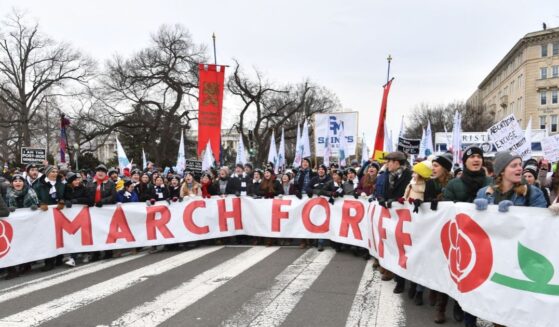


For many Americans, the terms “pro-life” and “anti-abortion” are essentially interchangeable. If someone opposes abortion, they are pro-life. What else is there to say?
As it turns out, quite a bit.
A growing faction of abortion opponents is rejecting the traditional “pro-life” label, arguing that the mainstream movement has fallen short of what they believe should be its ultimate objective: treating unborn children as equal under the law.
They call themselves abortion abolitionists, and while they share the pro-life movement’s opposition to abortion, the similarities actually largely end there.
The distinction is more than semantics. It represents a growing ideological divide within the broader conservative movement over what it actually means to end abortion in America.
At the center of that divide is a fundamental disagreement over how abortion should be treated under criminal law.
The abolitionist position is relatively straightforward: If an unborn child is a human being entitled to the same protections as everyone else, then intentionally killing that child should be treated as homicide.
That means extending equal protection under the law to unborn children, applying existing homicide laws and other relevant criminal statutes to abortion, and holding those responsible for an abortion legally accountable.
In a document called the Norman Statement on the Abolition of Abortion, Abolitionists Rising lays out the movement’s foundational principles. Among its central commitments is the belief that abortion must be criminalized as murder and that unborn children deserve the same legal protections afforded to born people.
The statement also makes clear that abolitionists reject the idea of giving mothers blanket immunity from prosecution when they knowingly and willfully participate in the killing of their unborn children.
That last point is perhaps the biggest dividing line between abolitionists and much of the established pro-life movement.
Many mainstream pro-life organizations oppose criminal penalties for women who obtain abortions, arguing that mothers should be viewed as victims of the abortion industry rather than perpetrators of a crime.
Abolitionists, however, contend that such exemptions create a glaring inconsistency. If abortion is the unlawful killing of a human being, they argue, the law should not automatically exempt one participant simply because of her relationship to the victim.
That disagreement has taken on added significance with the growing availability of mail-order abortion pills.
Even in states with abortion restrictions, pills like mifepristone and misoprostol can be obtained through telehealth providers and other sources, allowing women to carry out abortions without visiting a traditional abortion clinic.
The Foundation to Abolish Abortion recently highlighted the problem in its September 2026 report called “Babies Unprotected.”
The organization analyzed abortion numbers in 13 states with general abortion provider bans and four states with six-week provider bans. It reported that at least 292,534 unborn children from those states were aborted in 2025, compared with 234,774 in 2019.
The organization attributed the continued increase, in part, to self-managed abortions and telehealth abortion pills, arguing that laws exempting women from criminal or civil liability leave a significant loophole.
But the disagreement between the two movements extends beyond criminal penalties.
The Norman Statement also rejects incremental abortion restrictions that regulate abortion without eliminating it. Abolitionists argue that legislation allowing some abortions, even while restricting others, falls short of the goal of equal protection.
They also emphasize the explicitly Christian foundations of their movement, arguing that abortion abolition should be pursued as a matter of biblical conviction rather than political pragmatism.
Signing you in…
Please keep this page open. The results will appear here.
Check your email to count your vote
We sent a confirmation link to .
Click Confirm Your Vote in that email to count your vote and unlock the results.
Your vote has not been counted yet. If the email hasn't arrived, check your spam or junk folder.
None of this means every person who identifies as pro-life disagrees with abolitionists on every issue. Indeed, the Norman Statement explicitly acknowledges that well-meaning pro-life individuals are not necessarily in need of repentance simply for using the label.
Rather, abolitionists believe the distinction matters because it identifies a different approach to achieving the same broad objective.
For Americans encountering the term for the first time, understanding that distinction is important. The debate isn’t simply about whether abortion should be opposed.
It’s about what equal protection for unborn children should actually look like — and whether that protection should carry the same legal consequences it does for everyone else.