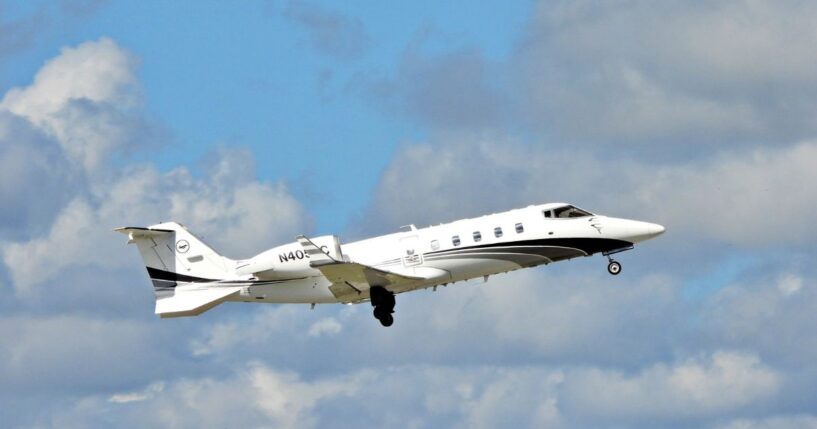
Crashed Learjet Audio Recorded Months Ago Captured Exasperated ATC Ordering Male, Female Pilots to Correct Flight Maneuver


The cause of Sunday’s private jet crash near Palm Beach, Florida, close to President Donald Trump’s Mar-a-Lago estate, may have been hidden in air traffic control audio from May of this year, according to reports that surfaced after the crash.
All nine people on board the Learjet 60 were killed after the plane plummeted to the ground. It was traveling from Austin, Texas, to the Bahamas when it encountered what one of the pilots called “light, clear ice that is manageable and moderate turbulence.”
Moments after she requested clearance to fly up to 37,000 feet, she declared a “mayday” emergency and said the plane was “descending 20,000 feet per minute” in heavy rainstorms.
“We’re going to crash into the ground,” she screamed on the radio.
🚨Audio has just been released from the Learjet 60 business jet that crashed near West Palm Beach, Florida.
“Mayday, Mayday, we’re descending 10,000 feet per minute… We’re out of time…”
This was just 8 miles from Trump’s home at Mar-a-Lago.
Absolutely horrific. https://t.co/BFJWKXjEU8
— Benny Johnson (@bennyjohnson) November 1, 2026
The decision to climb above the storm raised questions about icing and whether the plane was outside of its operating envelope at that height — the so-called “coffin corner” where the slowest safe speed and the fastest safe speed at which an aircraft is designed to operate are very close together.
However, the Daily Mail reported Monday on another incident involving the same plane in New York City-area airspace in May where an air-traffic controller rebuked a female pilot for calling serious turbulence “moderate” — and a former pilot turned social media aviation expert concurred that Sunday’s so-called “moderate” turbulence was likely more serious.
It’s unknown whether the female pilot flying the Learjet in May was Nathalia Gadelha Filgueiras, the 20-year-old who was co-piloting the plane on Sunday.
However, in the clip that the Daily Mail found, a controller rebuked her when she was flying over Newark, New Jersey.
“Why are you climbing?” the controller asked.
“We are just about to call you, we are experiencing moderate [turbulence] and unable to hold altitude,” the female pilot responded.
“That is not moderate, descend to 4,000 [feet] immediately,” the controller responded in a firm voice. “If you can’t maintain altitude that is not moderate, that is severe turbulence, are you experiencing severe turbulence?”
Both the female voice and a male voice responded, “Affirmative, sir.”
Six months before it crashed in Florida, the same Learjet was fighting severe turbulence on its way into Teterboro.
Listen to their voices and tell me if that sounds like the same pilots to you!
They acted arrogant and tried to argue with the controller, who then embarrassed them with a scolding.
On May 6, Learjet 60 N722BD climbed above its assigned 4,000 feet on approach. The controller ordered it back down immediately and told the crew that if they couldn’t hold altitude, it wasn’t moderate turbulence, it was severe.
ATC then warned other traffic that the jet was unable to maintain altitude and was showing 3,600 feet. By sheer luck, it landed safely at Teterboro.
On November 1, they weren’t so lucky and we know what unfortunately happened next.
This replay was built from public flight tracking data and amateur air traffic control audio.
— USA NEWS 🇺🇸 (@usanewshq) November 3, 2026
Steve Scheibner — a former airline pilot whose “Captain Steeeve” aviation YouTube channel has over 1.25 million subscribers — seemed to agree that Sunday’s incident followed the same pattern in a video on the crash.
Signing you in…
Please keep this page open. The results will appear here.
Check your email to count your vote
We sent a confirmation link to .
Click Confirm Your Vote in that email to count your vote and unlock the results.
Your vote has not been counted yet. If the email hasn't arrived, check your spam or junk folder.
“She says we’re plus or minus 700 feet. So she describes this as moderate turbulence. That’s severe turbulence,” Scheibner said in the Monday video.
“If you can’t maintain altitude plus or minus 700 feet, you don’t really have full aircraft controllability. In my opinion, that’s severe turbulence.”
“It’s up to the opinion of the pilots how they want to describe that,” he added. “This is as extreme moderate as you can get without calling it severe — plus or minus 700 feet, this aircraft is virtually out of control.”
While the cause of the crash is not necessarily clear, the National Transportation Safety Board is still on the scene investigating. According to Reuters, officials said the plane may have broken up before it hit the ground.
Advertise with The Western Journal and reach millions of highly engaged readers, while supporting our work. Advertise Today.
Truth and Accuracy
We are committed to truth and accuracy in all of our journalism. Read our editorial standards.