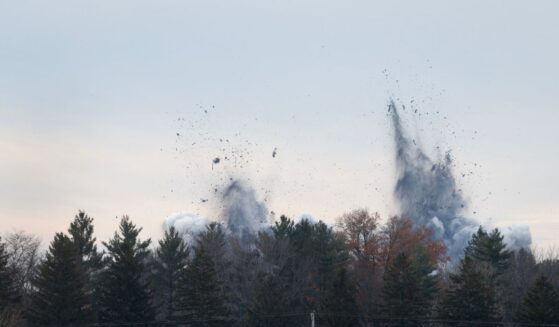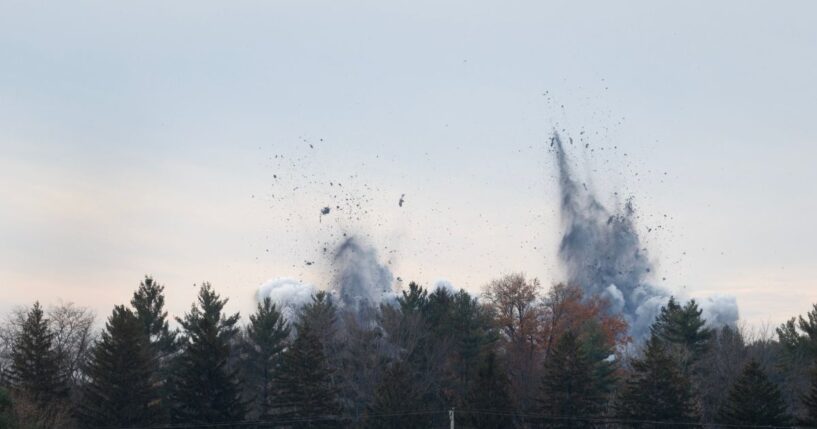



On Wednesday morning, the U.S. Army detonated nearly five tons of degraded explosive material — lead azide — in southeast Iowa.
Early reports suggested the mitigation measures were “successful” and that the explosion was “well-contained.”
The controlled, mitigated detonation of the lead azide stored at the Iowa Army Ammunition Plant has taken place.
Initial analysis shared with us by federal partners and Iowa Homeland Security and Emergency Management indicates that the mitigation measures appear to have been successful and the explosion was well-contained.
Our state agencies will continue monitoring efforts.
— Governor Mike Kehoe (@GovMikeKehoe) November 25, 2026
In preparation for the detonation, a Tuesday report by Iowa Capital Dispatch quoted Rob Cekada, director of the U.S. Bureau of Alcohol, Tobacco, Firearms and Explosives, who described lead azide as a “sensitive” primary explosive.
Nearly 10,000 pounds of lead azide — the “nation’s stockpile” — was moved to the Iowa Army Ammunition Plant in 2009 under President Barack Obama.
The lead azide’s sensitivity, the mixture’s crystallization, and the coming winter months created a dangerous situation that, the Army argued, could lead to spontaneous detonation.
To avoid this catastrophe, the Army planned a controlled detonation, but not without significant intervening forces — lawsuits, delays, and presidential pauses on military action.
The concern was real. Health and Human Services Principal Deputy Assistant Secretary for Preparedness and Response Sean Kaufman said that some level of risk was present, particularly for pregnant individuals, children, or people with chronic illnesses.
Because of this risk, Iowa Gov. Kim Reynolds issued a disaster declaration.
People near the detonation were advised to evacuate, and FEMA Administrator Cameron Hamilton promised they would “spare no expense to ensure that Americans are kept safe,” offering transportation, food, and relocation assistance, as reported in the Iowa Capital Dispatch.
After public pushback, officials also added more safety features to the blast site.
The structure holding the barrels was surrounded by sand, aqueous foam was released to absorb particulate matter, and gallons upon gallons of “water walls” were set up to absorb much of the blast.
A U.S. Army social media post showed a video of the safety measures and assured citizens that Army personnel have “worked around the clock to mitigate the impacts of the planned controlled detonation.”
U.S. Army personnel are on site in Middletown, Iowa, and have worked around the clock to mitigate the impacts of the planned controlled detonation later this morning.
This includes a water wall filled with more than 100,000 gallons of water, earth berms, sand filled blocks, expert dispersion modeling, and temperature-regulating tarps.
Our foremost priority is public health and safety, so take a look at how we’re protecting the community ⬇️
— U.S. Army (@USArmy) November 25, 2026
Col. Aaron Teller, the Army Explosive Ordnance Disposal commander in charge, seemed very optimistic going into this operation, according to the Iowa Capital Dispatch.
A similar lead azide detonation from 1977 — with zero mitigation — released 25 percent of lead material into the atmosphere.
Teller believes they can “significantly reduce” the final 25 percent “with the mitigation strategy that we have in place.”
Acting Army Secretary Adam Telle said that “every expert” in and outside of the federal government had been consulted, and that “there is consensus across the experts across the country that a controlled, mitigated detonation… is far preferable to an uncontrolled spontaneous detonation of that substance.”
And so, the detonation was set for Wednesday at 9 a.m.
Signing you in…
Please keep this page open. The results will appear here.
Check your email to count your vote
We sent a confirmation link to .
Click Confirm Your Vote in that email to count your vote and unlock the results.
Your vote has not been counted yet. If the email hasn't arrived, check your spam or junk folder.
Up until the blast, the Army continued to release lead deposition maps showing where the lead could be dispersed. The most recent maps suggested it could go as far as 100 miles southwest of Middletown and into Missouri.
FEMA continued to help evacuate citizens, and the EPA had a “blanket” of agents in the region collecting pre-detonation samples, per EPA representative Thomas Croci.
Amid the final preparation efforts, Reynolds said on Tuesday that she appreciated the Army’s “due diligence, responsible approach, and focus on the public health and safety of Iowans in nearby communities.”
After all of this preparation, the Army proceeded with the plan. The detonation occurred Wednesday morning.
My drone video of the #Iowa detonation moments ago. #detonation #army https://t.co/CNnbJ8sgwo
— James Wilson (@nmjameswilson) November 25, 2026
A social media post by Nick Sortor gave a look at the plume of smoke arising from the detonation zone.
🚨 BREAKING: The US Army has officially detonated 10,000 pounds of lead azide in Iowa, and plumes have been spotted
The smoke plume you’re seeing is said to be a mixture of C-4 explosives and diesel fuel — NOT necessarily lead particles
The Army says they’ve put safeguards in place to capture lead particles, but there is a risk of it escaping. Residents in a 20 mile radius are being told to shelter in place until an all-clear is given.
— Nick Sortor (@nicksortor) November 25, 2026
Patrick O’Shaughnessy, a professor of occupational and environmental health at the University of Iowa, noted that the lead plume would be invisible, confirming Sortor’s conclusion that the smoke plume is primarily explosives and fuel.
While the lead cloud would be invisible, the EPA’s live sampling monitor, which updates every five minutes, detected no lead in the air at the time of publication.
The story continues to develop as post-detonation tests and samples continue, yet all initial signs look hopeful.